Pedagogical method
Experience an educational journey without limits. Get your passport to the job market of the future with Campus 42.


Pedagogical method

PROJECT-BASED LEARNING
At 42 you will be responsible for your own success with a 100% practical curriculum, based on project development and overcoming challenges.
PEER-TO-PEER
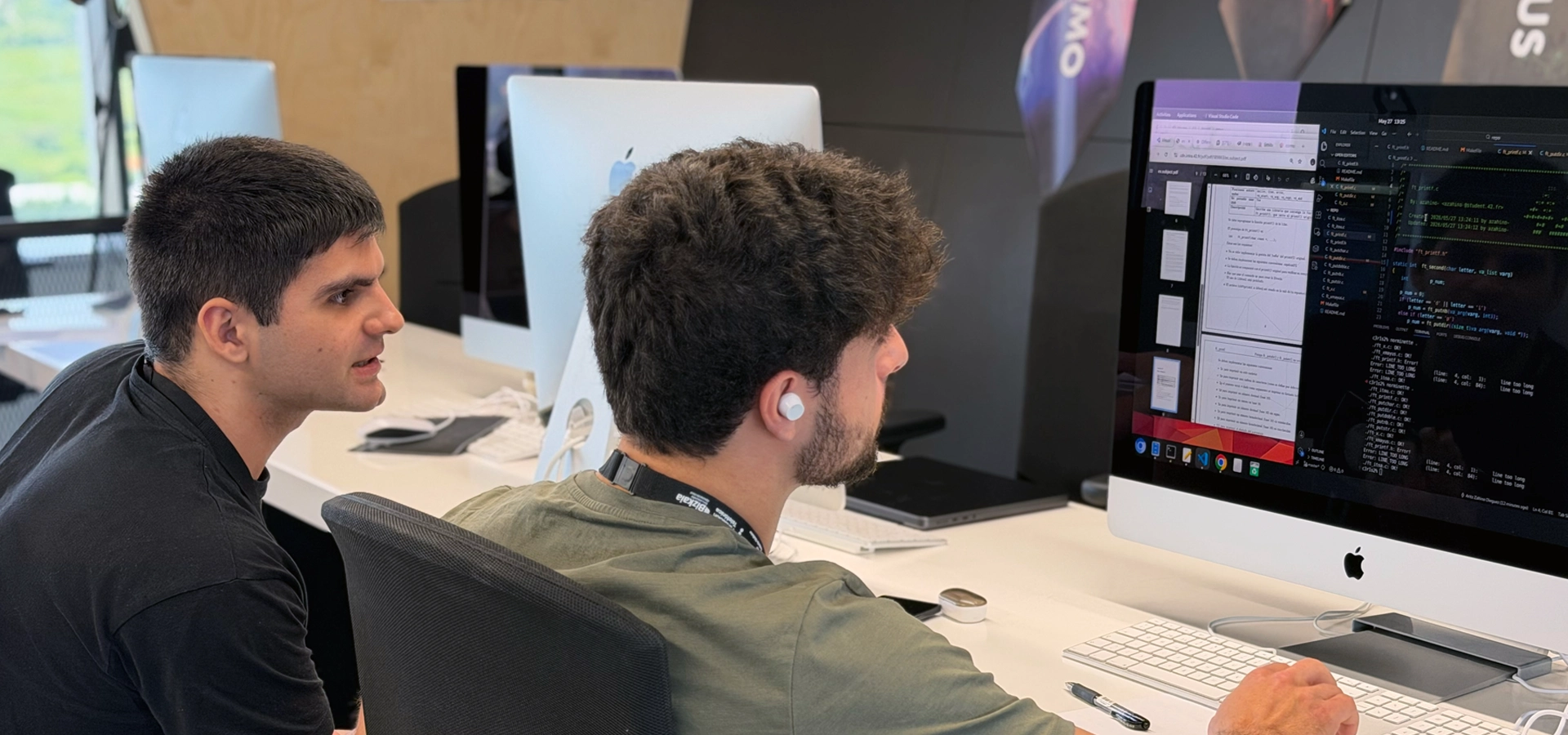
If you join 42, don’t expect someone with expertise to take on the role of a teacher. You’ll have to find the answers to the challenges set, and the best way to do this is with the help of those learning alongside you. This way of working will enable you to progress and hone your professional and social skills. ‘Peer-to-peer’ or collaborative learning will help you make your way in an ever-changing professional environment.
FAILURE IS PROGRESS
Failures do not mean the end. On the path to success, you must try things out, understand your mistakes, correct them and keep moving forward. At 42, you are rewarded for finding your own solutions and being able to share them. Failure is not penalised.
PEER ASSESSMENT
In the traditional education system, assessment takes place at the end of the curriculum. At 42, assessment is continuous and carried out by peers; in other words, you will learn to evaluate the work of others and will be assessed by your fellow students through the campus’s unique pedagogical model. This type of assessment promotes dialogue and analysis, and enables the sharing of knowledge and experience through advice, best practice and diverse perspectives on the same project. Above all, it fosters collaborative learning.
GAMIFIED LEARNING
42 offers a motivating environment that enhances the quality of teaching and the wellbeing of those learning on campus. As you progress through the curriculum, you achieve milestones, unlock circles and levels, and the student experience encourages you to excel and share as you acquire skills and competencies.
TEAMWORK
At 42, collaboration and teamwork are encouraged. The methodology encourages learners on campus to share their thoughts and concerns, as well as their perspectives on tackling challenges.
NO LECTURES, NO PROFESSORS
Thanks to an innovative methodology, at 42 we offer training without the need for lectures. To progress at 42, you have access to a learning experience based on projects, levels, assessments and exams, in which you and your fellow students take the lead and are responsible for your own progress. To do this, you’ll need to work as a team, collaborate with the community to overcome challenges, and share knowledge and experience with your peers.
This kind of learning increases knowledge of a subject by means of active exploration of real-world challenges and problems. You learn by doing and thinking critically, rather than by following instructions and memorising.
There are two compulsory internships. The first one has to be completed once the common core has been passed and it can take place at all kinds of companies, ranging from technology companies to startups, and in any position or job profile. The second one must be completed in a position or profile related to technology and the learning at 42. Most importantly, each student decides at which company and when he/she wants to complete them.
The projects are evaluated by the students by using a mark sheet and the general guidelines provided by the teaching staff. The students should be able to explain their code to the evaluator in a way that the latter will understand it, even if he/she has no knowledge of it prior to the evaluation. The mark will be determined by how well your code works and how well you can explain it.
Finding the internships required to validate the course forms a crucial part of the learning process. The campus provides a way of acquiring knowledge and confidence and gaining access to companies and institutions by means of talks, workshops and other events. However, it’s ultimately up to each individual to make the decision and take up the challenge.
Once students have passed the ‘pool’ stage, they follow a core curriculum across all campuses worldwide, alongside a technical specialisation component. The learning pathway consists of 21 levels.
The first part, the ‘Common Core’, comprises seven layers of projects and exams, focusing primarily on learning C, Python and JavaScript. Once the final layer has been completed, students become eligible for their first work placement. From this point onwards, it is up to the student to decide when to undertake it.
The second part focuses on the areas of specialisation that each student wishes to develop at their campus. Topics covered include: cybersecurity, web development, programming, AI, blockchain, DevOps, etc. This content is constantly updated to keep pace with developments in the technology sector.
During the ‘Common Core’, you will learn C, Python and JavaScript, and you will explore general-purpose artificial intelligence, RAG and intelligent agents.
In the specialisation, the programming languages depend entirely on the projects you are working on.
It is a universally applicable programming language, highly compatible with hardware compared to others. By working with C, you develop a deep understanding of computers and their operating systems and learn how applications affect these systems. With the knowledge and insight gained from programming in C, it is often easier to learn other languages later on.
Artificial Intelligence is not an optional extra or a mere add-on; rather, it is woven throughout 42’s learning curriculum, ranging from fundamental concepts to the creation of architectures for fully autonomous systems. AI is integrated by design and in a progressive manner, not simply to follow a trend. The aim is that, upon completing your studies, you will be able to design, develop and critically evaluate AI-integrated solutions to address the current challenges facing the industry.
You progress through the study plan by completing projects and earning points. With these points you go up through the levels and unlock more projects and branches of specialisation. You can also master different skills and complete missions and achievements.
The original curriculum was created in 2013 by the Campus 42 Paris team, a group of veterans in the field of IT education in France. Since then, it has evolved thanks to contributions from teaching staff across the global network of campuses, cooperation with companies, and even input from students. Every quarter, the teaching committee—made up of teaching staff from all campuses—meets to discuss and implement updates to the curriculum based on current industry trends.